You open Snapchat, read a message, and see someone type, “IMK, she already left.” You understand the rest of the sentence, but those three letters make you pause.
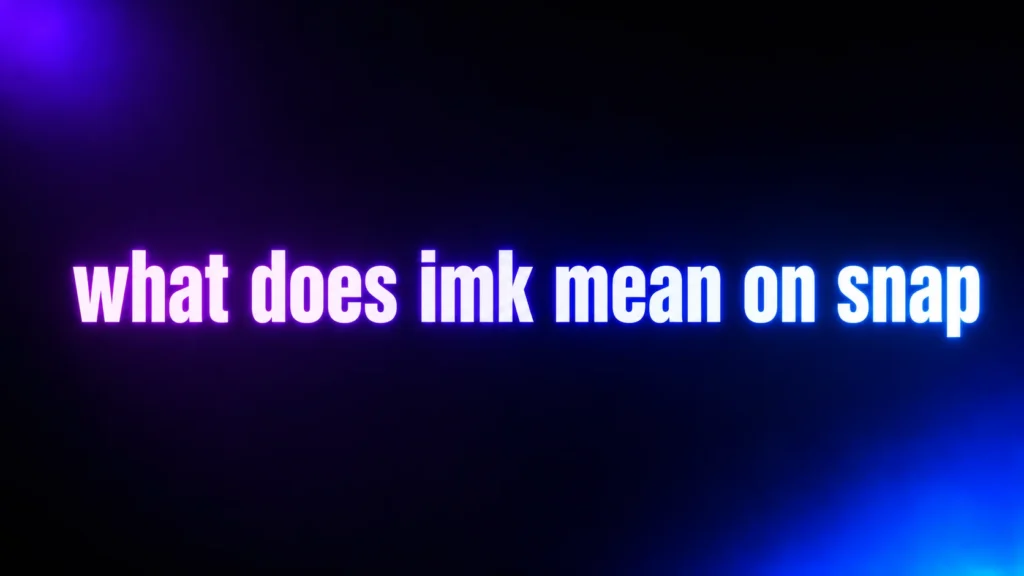
So, what does IMK mean on Snap?
In most texting and social media conversations, IMK means “In My Knowledge.” It is a casual way of saying “as far as I know,” “from what I understand,” or “based on what I know.” The person is sharing information while leaving a little room for uncertainty.
The confusion is understandable because IMK is not as universally recognized as abbreviations such as LOL, IDK, or IMO. It can also look like a typo, especially when someone sends it quickly in a Snapchat conversation.
Context matters too. Internet abbreviations are not controlled by a single dictionary, and the same letters can occasionally be used differently by different communities. Still, when IMK appears before a statement about something a person believes to be true, “In My Knowledge” is usually the intended meaning.
Once you understand the tone behind it, IMK becomes much easier to read. It is not only about sharing information. It can also signal caution, confidence, uncertainty, or even a desire to avoid taking full responsibility for a claim.
What Does IMK Mean on Snap? Quick Meaning
IMK means “In My Knowledge.”
On Snapchat, it is commonly used when someone wants to share what they know without claiming that they are 100% certain.
Think of it as a shorter version of:
- “As far as I know”
- “From what I know”
- “Based on what I understand”
- “To my knowledge”
For example:
“IMK, the party starts at 8.”
This means: “As far as I know, the party starts at 8.”
“IMK, they aren’t talking anymore.”
This means: “From what I know, they aren’t talking anymore.”
“He’s still coming, IMK.”
This means: “As far as I know, he’s still coming.”
The phrase often makes a statement sound less absolute. Instead of saying, “This is definitely true,” the sender is saying, “This is what I currently believe to be true.”
That small difference can completely change the emotional tone of a message.
Origin & Background
IMK belongs to the wider culture of internet abbreviations that developed as digital conversations became faster and more informal.
People naturally shorten common expressions when texting. “I don’t know” became IDK. “In my opinion” became IMO. “As far as I know” became AFAIK.
In a similar way, “In My Knowledge” became IMK.
The abbreviation is commonly recognized in online slang references as a way of introducing information based on a person’s own understanding rather than absolute certainty.
Unlike some slang terms that are strongly connected to one platform, IMK is not exclusive to Snapchat. You may see it in text messages, Instagram DMs, WhatsApp chats, gaming communities, comment sections, and other informal online spaces.
Social media helped abbreviations like IMK travel between communities. A term may begin in one type of online conversation and then spread through screenshots, group chats, comments, memes, and everyday messaging.
Its meaning has also become flexible in practice.
Some people use IMK carefully to mean, “This is what I know, but I could be wrong.” Others use it with much more confidence, almost like saying, “From everything I know, yes.”
That is why the words surrounding IMK matter as much as the abbreviation itself.
Real Life Conversations
Seeing IMK inside a natural conversation makes its meaning much easier to understand.
WhatsApp Conversation
Person A: Is Sara coming to dinner tonight?
Person B: IMK, yes. She said she was leaving work early.
Person A: Okay, I’ll save her a seat.
Person B: Maybe message her first though. She hasn’t replied to me since this afternoon.
Here, Person B believes Sara is coming but does not want to guarantee it.
The phrase “IMK, yes” quietly communicates: “That is the information I have, but something may have changed.”
Instagram DMs
Person A: Wait, are Maya and Daniel actually back together?
Person B: IMK, they’re just talking again.
Person A: Everyone is saying they’re dating.
Person B: People assume things too quickly. I wouldn’t believe everything yet.
In this conversation, IMK helps the sender separate personal knowledge from online rumors.
The sender is not saying, “I know the complete truth.” They are saying, “Based on what I know right now, this is the situation.”
TikTok Comments
Person A: Didn’t this creator already announce a new account?
Person B: IMK, that account is fake.
Person A: Seriously? I almost followed it.
Person B: Yeah, wait until they confirm it themselves.
Here, IMK introduces a warning without presenting the information as unquestionable fact.
Text Messages
Person A: Are you still coming tomorrow?
Person B: Yeah, IMK I am. My family might change the plan though.
Person A: Just let me know when you’re sure.
Person B: I will. I really want to come.
This example shows a slightly looser use of IMK. The person is describing what they currently expect to happen while acknowledging that circumstances may change.
Emotional & Psychological Meaning
IMK may look like a simple abbreviation, but its emotional purpose is often more interesting than its literal definition.
People use it because absolute statements can feel risky.
Imagine telling your friend:
“They’re definitely breaking up.”
That sounds confident. If the information turns out to be wrong, you may look like you were spreading a rumor.
Now compare it with:
“IMK, they’re having problems.”
The second version creates distance between you and the claim. You are sharing what you know while quietly admitting that your information may be incomplete.
Psychologically, this kind of language acts as a softener.
It allows people to participate in a conversation without presenting themselves as the final authority. Depending on the situation, it can communicate honesty, caution, uncertainty, or social awareness.
I have seen this pattern repeatedly in everyday online conversations: people often add a small phrase such as “I think,” “apparently,” “from what I heard,” or “IMK” when they sense that a topic is sensitive.
The extra hesitation is meaningful.
It often shows that the person understands there may be another side to the story.
That is especially important in digital communication, where facial expressions and vocal tone are missing. A three-letter abbreviation can become a substitute for the hesitation you might naturally hear in someone’s voice during a face-to-face conversation.
Usage in Different Contexts
Social Media
On Snapchat and other social platforms, IMK is usually used when sharing information, opinions based on personal knowledge, or updates that may not be fully confirmed.
For example:
“IMK, the event was canceled.”
The sender believes the event was canceled but may not have official confirmation.
On Snapchat, where conversations are often quick and informal, shortening a phrase makes sense. People frequently communicate in fragments, abbreviations, reactions, and brief replies.
Friends & Relationships
Among friends, IMK can be especially useful when talking about plans, mutual friends, relationships, or social situations.
For example:
“IMK, he isn’t mad at you.”
That message may be reassuring, but it also acknowledges that the sender cannot completely speak for another person’s feelings.
In relationships, tone becomes more important.
Consider:
“IMK, we’re fine.”
Depending on the conversation, this could sound relaxed, uncertain, defensive, or emotionally distant.
The abbreviation itself is neutral. The surrounding situation creates the emotional meaning.
Work / Professional Settings
IMK is generally better suited to casual communication than formal professional writing.
A coworker might type:
“IMK, the meeting is still at 3.”
That can feel natural in a relaxed team chat.
However, in an important email to a client or manager, clearer wording is usually better:
“To my knowledge, the meeting is still scheduled for 3 p.m.”
Professional communication often benefits from complete language because uncommon abbreviations can create unnecessary confusion.
Casual vs Serious Tone
IMK usually has a casual or conversational tone.
It works naturally in:
- Snapchat messages
- Group chats
- DMs
- Friendly texts
- Informal online discussions
In serious situations involving health, legal matters, safety, money, or important instructions, vague language can be risky.
When accuracy matters, it is better to explain exactly what you know and what remains unconfirmed.
When NOT to Use It
IMK is useful, but it is not appropriate everywhere.
Avoid using it when the person reading your message may not understand internet abbreviations. Someone unfamiliar with slang may spend more time decoding the letters than understanding your actual point.
It is also better to avoid IMK in formal documents, job applications, academic writing, important business emails, and official communication.
For example:
“IMK, the payment has been processed.”
That may be too vague in a professional financial conversation.
A clearer version would be:
“According to the information currently available to me, the payment has been processed.”
You should also be careful when discussing rumors.
Adding “IMK” does not automatically make an unverified claim responsible. Saying “IMK, they cheated” can still spread harmful information about another person.
Cultural and language differences matter as well. Not every English-speaking community uses the same online abbreviations. A term that feels obvious in one friend group may be completely unfamiliar in another.
When clarity matters more than speed, write the full meaning.
Common Misunderstandings
The biggest misunderstanding is assuming that everyone uses IMK in exactly the same way.
They do not.
The most commonly recognized meaning in casual texting is “In My Knowledge,” but some online sources also record alternative interpretations. This is why context remains essential.
Another mistake is confusing IMK with IDK.
They communicate almost opposite ideas.
IDK means:
“I don’t know.”
IMK means something closer to:
“Based on what I know…”
People also sometimes assume IMK expresses complete certainty.
Usually, it does not.
When someone says:
“IMK, he’s at home.”
They are normally not saying, “I have personally confirmed that he is definitely at home.”
They are saying, “According to what I know, he is at home.”
Tone can create another layer of confusion.
“IMK…”
followed by a pause or uncertain wording may sound hesitant.
But:
“IMK, that’s exactly what happened.”
can sound much more confident.
The abbreviation stays the same. The sentence around it changes its force.
Comparison Table
| Term | Meaning | Tone or Purpose |
| IMK | In My Knowledge | Shares information based on personal understanding |
| AFAIK | As Far As I Know | Very similar to IMK |
| IMO | In My Opinion | Introduces a personal opinion |
| IMHO | In My Humble Opinion | Softens a personal opinion |
| IIRC | If I Recall Correctly | Shows uncertainty about memory |
| Apparently | Based on what has been heard or observed | Often used for unconfirmed information |
| IDK | I Don’t Know | Expresses lack of knowledge |
| For sure | Definitely | Shows stronger certainty |
| Definitely | Without much doubt | More certain than IMK |
| FYI | For Your Information | Introduces useful information |
Key Insight
IMK is closer to AFAIK than to IDK. It does not mean the sender knows nothing; it means they are sharing what they currently understand while leaving room for correction.
Variations / Types
IMK does not have ten completely different official definitions. However, it can appear in several practical sentence patterns and tone variations.
1. “IMK, yes”
Meaning: As far as I know, yes.
Used when giving a positive answer without making an absolute guarantee.
2. “IMK, no”
Meaning: As far as I know, no.
Used when the sender believes something is not true or has not happened.
3. “IMK, they are…”
Meaning: Based on what I know about the person.
Often used when discussing someone’s situation, plans, or actions.
4. “IMK, they said…”
Meaning: According to the information I have.
This often appears when repeating information from a previous conversation.
5. “That’s true, IMK”
Meaning: I believe that information is correct.
The sender agrees but leaves a small amount of uncertainty.
6. “Not IMK”
Meaning: Not according to what I know.
This is a less common but understandable way to disagree with a claim.
7. “At least IMK”
Meaning: At least based on my current understanding.
This form emphasizes that other information may exist.
8. “IMK so far”
Meaning: Based on everything known up to this point.
Useful when a situation may still change.
9. “IMK, but check”
Meaning: I believe this is correct, but confirm it yourself.
This is one of the more responsible ways to use the abbreviation when certainty is limited.
10. “IMK…” with hesitation
Meaning: The sender thinks they know but feels uncertain.
Punctuation, pauses, and surrounding words can make IMK sound much less confident.
How to Respond When Someone Uses It
Your response depends on what the person is telling you.
Casual Replies
Them: “IMK, we’re meeting at 7.”
You: “Okay, sounds good.”
Them: “IMK, she’s coming too.”
You: “Nice, I haven’t seen her in ages.”
Funny Replies
Them: “IMK, he’s finally on time.”
You: “I’ll believe it when I see him.”
Them: “IMK, the teacher forgot about the assignment.”
You: “Nobody remind them. Protect the peace.”
Mature Replies
Them: “IMK, they aren’t together anymore.”
You: “I understand. I’ll wait until they say something themselves.”
Them: “IMK, the plan has changed.”
You: “Thanks for telling me. I’ll confirm before I leave.”
Respectful Replies
Them: “IMK, she doesn’t want to talk about it.”
You: “That’s okay. I won’t pressure her.”
Them: “IMK, the information isn’t public yet.”
You: “Understood. I won’t share it.”
The best response usually acknowledges the information without pretending it is more certain than the sender intended.
Regional & Cultural Usage
Western Culture
In many Western English-speaking online communities, expressions such as AFAIK, IMO, I think, and as far as I know may be more immediately recognizable.
IMK can still be understood from context, but it is not necessarily familiar to every user.
This is important because online slang does not spread evenly. Two people of the same age can use completely different abbreviations depending on their social circles and platforms.
Asian Culture
Across Asian digital communities, English abbreviations frequently mix with local languages in everyday messaging.
A person may write most of a message in Hindi, Urdu, Bengali, Filipino, or another language and insert an English abbreviation such as IMK, IDK, LOL, or BTW.
The result is a flexible style of communication where meaning depends heavily on the group using the term.
Middle Eastern Culture
In Middle Eastern online conversations, English slang may also appear alongside Arabic or other languages.
Users who regularly communicate internationally may recognize abbreviations quickly, while others may prefer complete phrases.
Because IMK is less universally known than LOL or IDK, writing “as far as I know” may sometimes prevent confusion in mixed-language or international conversations.
Global Internet Usage
Internet slang travels quickly, but it rarely develops one perfectly fixed global meaning.
A teenager may learn an abbreviation from Snapchat, another person from TikTok comments, and someone else from a gaming community.
That is why context remains the safest guide.
When IMK introduces a statement about what someone knows or believes, “In My Knowledge” is the most likely interpretation.
Gen Z vs Millennials
Gen Z communication often favors short, fast, highly contextual language. However, Gen Z slang also changes rapidly, and not every abbreviation becomes universally popular.
Millennials are also familiar with internet shorthand but may recognize older abbreviations such as LOL, BRB, IMO, and AFAIK more readily.
The difference is not absolute.
Your friend group, location, online community, and preferred platform can influence your vocabulary more than your generation alone.
Is It Safe for Kids?
Yes. IMK is generally a harmless abbreviation when it means “In My Knowledge.”
There is nothing inherently offensive or inappropriate about the term.
However, children and teenagers should understand that adding IMK before a rumor does not make sharing that rumor harmless. They should still think carefully before repeating private, sensitive, or unverified information about someone else.
The abbreviation is safe. The context in which it is used still matters.
FAQs
What does IMK mean on Snap?
On Snapchat, IMK usually means “In My Knowledge.” It is similar to saying “as far as I know” or “from what I understand.”
What does IMK mean in texting?
In texting, IMK commonly means “In My Knowledge.” The sender is sharing information based on what they currently know.
Is IMK the same as IDK?
No. IDK means “I Don’t Know,” while IMK means “In My Knowledge.” IMK suggests that the person does have some information.
Is IMK the same as AFAIK?
They are very similar. AFAIK means “As Far As I Know,” which usually communicates almost the same idea as IMK.
Can IMK have another meaning?
Yes, uncommon alternative interpretations can appear online. Always check the surrounding sentence, although “In My Knowledge” is a commonly recognized texting meaning.
Is IMK rude?
No. IMK is normally neutral. Its tone depends on the message, situation, and relationship between the people talking.
Should I use IMK in professional messages?
Usually, complete phrases such as “to my knowledge” or “as far as I know” are clearer and more professional.
Conclusion
So, what does IMK mean on Snap?
In most casual conversations, IMK means “In My Knowledge.” It is a quick way to say that something is true according to the information you currently have.
The real value of the abbreviation is not just speed. It adds a layer of caution.
When someone says, “IMK, the plan hasn’t changed,” they are not necessarily making a promise. They are telling you what they know at that moment.
That distinction matters.
Modern communication is full of small signals that help us express certainty, doubt, emotion, and social awareness without writing long explanations. IMK is one of those signals.
Once you recognize it, the meaning becomes simple: the person knows something, believes it is probably correct, but may still be open to new information.
Read the full sentence, pay attention to the tone, and consider the context. That is usually all you need to understand IMK confidently the next time it appears in a Snap, DM, comment, or text.